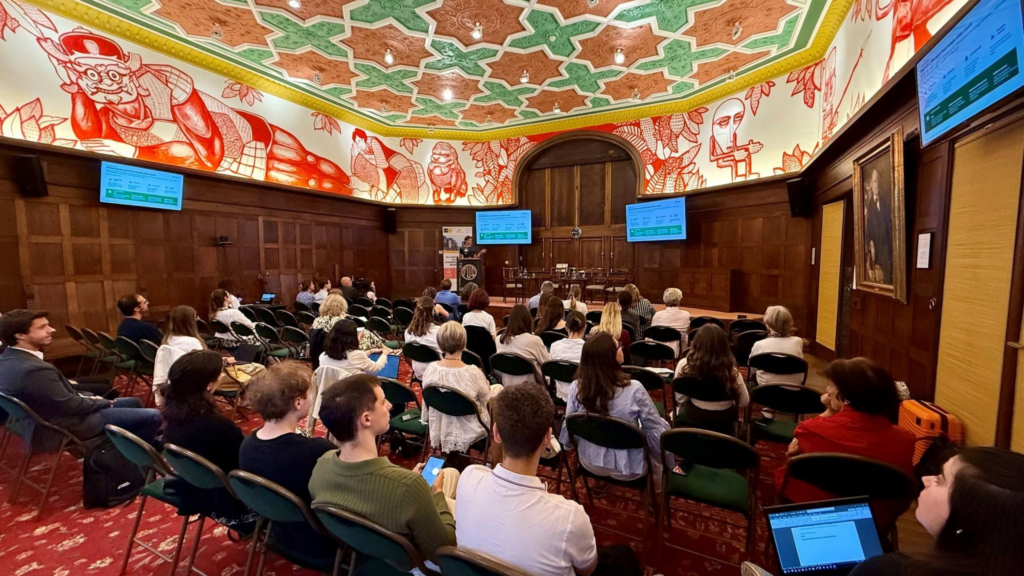
How can European cities move from ambitious circular economy strategies to practical implementation at scale? This question was at the heart of “Circular Cities in Action: AI-Powered Tools for Circular Transition at Scale”, a CircularPSP event bringing together city representatives, European policymakers, city networks and innovation experts in Brussels.
Marking an important milestone in the concluding phase of the CircularPSP programme, the event showcased the results of the project and explored how artificial intelligence and digital solutions can help municipalities turn circular economy ambitions into concrete action.
Cities across Europe are increasingly expected to accelerate the transition towards a circular economy. Yet moving from policy commitments to implementation remains challenging. Municipalities must navigate complex organisational structures, limited resources and capacity, fragmented data, procurement requirements and the need to coordinate circular action across departments and stakeholders.
CircularPSP has worked to address these challenges by developing and testing innovative digital solutions designed specifically for the needs of cities and public authorities.
Two AI-powered solutions for circular cities
A central part of the event was dedicated to CircOS and CircularAI, the two solutions developed through CircularPSP’s competitive pre-commercial procurement process.
Participants were introduced to the platforms through presentations and live demonstrations illustrating how artificial intelligence can support municipal staff in translating circular economy objectives into practical actions.
CircOS, presented by Kim Turk Mehes from VCG.AI, supports cities in translating circular strategies into structured missions, prioritised projects and collaborative workflows. By bringing together strategy, data, projects and teams, the platform is designed to help overcome municipal silos and can support cities throughout procurement processes.
CircularAI, presented by Vitória Fank Spohr from INNCISO innovation, supports municipal staff and local stakeholders in implementing circular economy principles through AI-assisted guidance, learning and project workflows. Its functionalities are designed to help users explore circular approaches, access relevant knowledge and strengthen decision-making.
Both solutions reflect a central principle explored throughout CircularPSP: AI can make complex information more accessible and support municipal teams in their daily work, while human expertise, local knowledge and strategic judgement remain essential.
From technology to practice: lessons from cities
The event went beyond presenting technological solutions by giving the floor to organisations that had tested the platforms in real-life contexts.
Francisco Ferreira from the Municipality of Guimarães and Dina Padalkina from Circular Berlin shared experiences and lessons from using the solutions, providing insights into the realities municipalities face when implementing circular economy principles.
Their contributions highlighted that circularity cannot be addressed only at the final procurement stage. Cities also need to consider how resources are managed internally, how departments collaborate and how circular economy objectives are translated into everyday municipal processes.
Another important consideration was the growing number of digital solutions available to public authorities. For cities, the objective is not simply to introduce another tool, but to ensure that digital platforms respond to genuine needs, integrate effectively into existing workflows and ultimately contribute to measurable environmental, organisational and economic benefits.
The city experiences demonstrated why testing solutions in real municipal environments has been a fundamental element of CircularPSP: technology must respond to the practical realities of the people and organisations expected to use it.
What will it take to scale circular solutions across Europe?
Following the presentations and demonstrations, a high-level roundtable turned the discussion towards the next challenge: how can innovative solutions move from successful pilots to wider adoption across European cities?
Moderated by Dr Drasko Veselinovic, Director of the Slovenian Business & Research Association (SBRA), the discussion brought together representatives from cities, the European Commission and leading European city networks.
Contributions from Pia Laurila, Team Leader for Cities at the European Commission’s DG REGIO; Francisco Ferreira, Municipality of Guimarães; Dina Padalkina, Circular Berlin; Helena O’Rourke-Potocki, ICLEI Europe; and Chiara V., Eurocities explored the policy, capacity, procurement and financing conditions required to support wider implementation.
Several priorities emerged from the discussion.
Municipal capacity remains fundamental. Although AI-powered tools can reduce workloads and make specialised knowledge more accessible, public procurers and municipal staff still require appropriate skills, training and professionalisation to make effective use of circular solutions.
Procurement also has an important role to play. Circularity needs to be considered throughout the development of municipal strategies and projects rather than only when a purchasing decision is made. At the same time, public procurement can help stimulate market transformation by encouraging suppliers to develop the skills and capabilities needed to deliver more circular solutions.
Financing represents another significant challenge. Many urban circular economy projects still struggle to attract investment, making stronger cooperation between public and private actors important for financing and de-risking the transition.
The discussion also connected these challenges with the wider European policy context. Pia Laurila presented the role of the EU Agenda for Cities and highlighted future priorities including climate action, environment and clean energy; competitiveness and digitalisation; and affordable and sustainable housing – areas in which circular economy approaches can make an important contribution.
From successful pilots to wider uptake
The Brussels event demonstrated how far CircularPSP has progressed: from identifying common municipal challenges and launching a joint innovation procurement process to developing, testing and demonstrating AI-powered solutions in real organisational environments.
However, technological readiness is only one part of the equation.
The next challenge is to create the conditions that enable successful solutions to be adopted more widely: appropriate procurement pathways, sustainable funding, municipal capacity, supportive policy frameworks and strong networks through which cities can exchange knowledge and experience.
This is particularly important because cities should not have to address the circular transition in isolation. By collaborating across borders, sharing requirements and jointly testing innovative approaches, public authorities can reduce risks while helping create solutions that respond to common European challenges.
As CircularPSP moves towards its final phase, the focus is therefore increasingly shifting from innovation to uptake and from successful experimentation to implementation at scale.
The Brussels discussions provided a valuable opportunity to bring together the different actors needed to make that transition possible – public authorities, technology providers, European institutions, city networks and circular economy practitioners.
CircularPSP would like to thank all speakers, panellists and participants for contributing their expertise and perspectives, and the Slovenian Business & Research Association (SBRA) for moderating the discussion and hosting the event at the University Foundation in Brussels.
The conversation does not end here. The experience and solutions developed through CircularPSP provide a foundation for continued collaboration and for helping more European cities turn circular economy ambitions into practical, measurable action.